
Freestone County Release Records
A release means that one agency has ended a specific period of custody. It does not always mean that the person walked into the community. The Freestone County Sheriff’s Office owns the local booking and release record for a person who left the Freestone County Jail. The Texas Department of Criminal Justice, or TDCJ, owns state-prison status and discharge information. Federal Bureau of Prisons and immigration systems cover still other forms of custody.
The difference matters in this county. A person may leave the Sheriff’s jail on bond, after time served, under a court order, or for transfer to TDCJ or another agency. Only some of those outcomes are community releases. If a name vanishes from a roster, ask where custody went next. A release timestamp, release type, court disposition, and receiving agency are stronger evidence than an empty search result.
- Release
- The end of custody by one agency, which may include a transfer.
- Discharge
- Completion of a sentence or supervision term, rather than merely leaving one building.
- Time served
- A court-recognized sentence satisfied by time already spent in custody.
- Detainer
- A request or hold from another authority that may cause a transfer instead of community release.
Freestone County Release Types
The release entry should be read with the court case and the agency that took the next action. Bond and time-served releases often return a person to the community, although another hold can change the outcome. A TDCJ commitment moves the person into state custody. Parole and mandatory supervision release a state prisoner under rules administered by Texas agencies. Full discharge ends the sentence, subject to any separate case or hold.
| Release entry | What it can mean | Best next record |
|---|---|---|
| Bond | County custody ended while the case continues | County or District Clerk case file |
| Time served | The court credited enough custody time | Judgment and jail release record |
| TDCJ transfer | Custody moved to the state system | TDCJ offender search |
| Parole or mandatory supervision | State confinement ended with supervision | TDCJ IVSS and Parole Division |
| Sentence discharge | The state sentence reached its end | TDCJ status and actual release date |
| Detainer transfer | Another authority took custody | Receiving agency locator or record |
A probation order differs from parole. Probation, called community supervision in Texas court records, is imposed by a court. Parole follows a period in state prison and is based on a Board decision. Neither label should be inferred from the fact that someone is no longer at the jail.
Freestone Release Record Fields
A focused request should identify the booking episode and ask for fields that establish what happened at the end of custody. Freestone County does not publish a field dictionary or a public release feed, so the Sheriff may provide existing records in the form maintained. Do not demand that staff create a new report. Ask for an electronic copy and a cost estimate before work begins.
| Field | What it helps confirm |
|---|---|
| Full name and identifiers | Whether the record belongs to the right person |
| Booking number | The exact custody episode |
| Booking and release timestamps | The start and end recorded by the jail |
| Release type or reason | Bond, court order, time served, transfer, or another recorded outcome |
| Charge and case number | The court file that may explain the release |
| Bond information | The bond tied to the case, if maintained |
| Receiving agency or hold | Whether custody moved elsewhere |
A released person normally leaves the active jail roster. The release record and court disposition remain the better paths for past custody.
Request Freestone County Release Records
The Freestone County Sheriff’s Office lists an open-records email but no online recent-release archive, posted records hours, or fixed fee schedule. The office is at 103 S. Keechi in Fairfield, uses P.O. Drawer 47 for mail, and can be reached at 903-389-3236. Requests may be sent to fcsorecords@co.freestone.tx.us.
- Give the person’s full name and any known date of birth, booking number, or booking range.
- Describe the existing booking and release records sought, including the release timestamp, type, charges, case number, and receiving agency if maintained.
- State an exact date range. For a daily list, provide both the start and end timestamp.
- Ask for electronic copies and request an estimate before any chargeable work begins.
- Save the response with the date received. If an item is withheld, read the cited basis and use the court record where appropriate.
A purpose-neutral request can ask for the booking sheet, recorded release date and time, release type or reason, public receiving-agency field, bond or release instrument held by the Sheriff, and booking photograph. Ask for any code legend already kept with the record. This wording seeks existing material and does not require staff to explain the case, research other agencies, or build a list that the office does not maintain.
For a range of releases, identify two exact timestamps and ask for records whose recorded release time falls within them. State which fields are sought. Avoid broad demands for protected medical, victim, juvenile, or security information. A narrower range also reduces name confusion and makes it easier to identify the correct booking episode.
Texas Government Code Chapter 552 governs public-information requests. It does not guarantee that every jail field, photo, or investigative detail will be released. Costs follow applicable state rules, and the research found no Freestone-specific fee promise. Juvenile material, active investigations, security information, expunction, and nondisclosure can limit access.
Section 552.108 contains the law-enforcement exception, while subsection (c) preserves basic information about an arrested person, arrest, or crime from that general exception. Other confidentiality rules can still apply. If the office withholds part of a record, ask for segregable public portions and the stated legal basis instead of assuming the whole release event is secret.
Freestone Court Release Records
Freestone’s criminal record route divides by court level. The County Clerk handles County Court materials and Class A or B misdemeanor records. Its published public-search link serves official and land records; it was not verified as a criminal name-search portal. A clerk request may be needed. The District Clerk holds felony and district-court records, including judgments that can explain a sentence or release order.
A case file may show bond, dismissal, sentence, jail credit, commitment, or later expunction and nondisclosure activity. Texas Code of Criminal Procedure Chapter 55A now governs expunction procedures. An expunction can require covered agencies to remove or return eligible records. Nondisclosure is different: it limits public disclosure of covered criminal-history information but is not the same as erasing every record. The live clerk pages should be checked before travel because hours can change.
Freestone Release Record Retention
Online retention is not the same as agency retention. Freestone County publishes no stated post-release window because the Sheriff provides no official public roster, release feed, or archive. A missing online entry therefore says nothing about whether the underlying booking and release record still exists. Ask the Sheriff for the specific custody episode under the office's applicable records schedule.
Legacy Texas VINE material described a 90-day period when released offender records remained searchable. That historic figure must not be assigned to the current IVSS-Counties portal. Texas moved county notifications to IVSS-Counties in September 2025, and current instructions do not establish the same public search window. Preserve a dated result and use the records request when the portal no longer shows an event.
TDCJ and court records follow their own systems and may persist much longer. TDCJ number history can connect an intake and release to a past state term. A court judgment or signed dismissal can outlive a jail listing. Retention can still be affected by expunction, nondisclosure, juvenile confidentiality, and other law, so an unavailable record is not proof that the person was never booked or released.
Chapter 55A replaced the former expunction chapter in 2025. Eligibility depends on the case facts and the current statute. Release or dismissal alone does not guarantee an expunction. A signed order, not an empty web search, explains why covered records may no longer be available. Orders of nondisclosure use a separate process and restrict ordinary public access without necessarily destroying the record.
Freestone Release Statistics Explained
TDCJ’s FY2024 statistical report lists 51 releases associated with Freestone County of conviction: 23 prison, 18 state jail, and 10 Substance Abuse Felony Punishment releases. The FY2023 report lists 33, including 22 prison and 11 state-jail releases.
These totals are not a count of releases from Boyd Unit or the Freestone County Jail. “County of conviction” describes the case geography used in the report. It cannot identify who left a local facility, and it must not replace an individual release record.
Find Freestone County Released Inmates
Start with the agency that last held the person. This prevents the most common error: treating a transfer as freedom. Freestone has no official public jail roster, 24-hour list, 72-hour archive, mugshot gallery, or verified Sheriff app link. The Sheriff’s record channel therefore leads the county-jail path.
- Contact the Sheriff for the specific booking and release entry. Ask whether the person left for the community or another agency.
- Check the correct clerk using the case level. A bond, dismissal, sentence, or commitment order may explain the jail departure.
- If the record shows TDCJ custody, use the state offender search and IVSS rather than continuing to search county sources.
- Use the Board and supervision offices for parole status, not as proof that a scheduled date became an actual release.
- When a federal or immigration transfer appears, move to BOP, federal court or USMS records, or ICE ODLS.
The Released Last 24 Hours page explains how to frame a same-day records request. The absence of a person from any portal proves little on its own. Spelling, data lag, sealed data, another hold, death, or a transfer can all produce a missing result.
Texas Search for Freestone Releases
The TDCJ inmate-information page links the official online, email, and telephone routes. The online offender search accepts name and identifying fields, and results may show current status, unit, projected date, parole information, and an actual release date. Search by TDCJ or state identification number when known. Name-only matches need careful comparison.
| Search field | Use |
|---|---|
| Last and first name | Basic lookup; spelling matters |
| TDCJ number | Best match for a known state-prison record |
| State identification number | Alternative Texas identifier |
| Sex and race | Narrows similar names where the form permits |
The TDCJ IVSS person search is a separate state-custody and notification path. It can expose offender status, expected and actual dates, number history, and subscription events. A projected or expected date is not proof of departure. Read the status and actual release date together.
Freestone Release Notifications Changed
Texas changed county notification branding from VINE to IVSS-Counties in September 2025. The Texas IVSS-Counties portal can cover booking, release, transfer, court, escape, and death events for participating counties. Participation is not universal, and historical Freestone grant records do not prove current live coverage. Test the county in the portal. If no matching record appears, contact the Sheriff.
State-prison notifications remain in TDCJ’s separate IVSS. That is the correct service for a person held at Boyd Unit or elsewhere in TDCJ. County IVSS and state IVSS should not be treated as one combined roster. Federal BOP and ICE cases are outside both systems.
Freestone Parole and Probation
Freestone parole geography maps through the TDCJ Athens District Parole Office, while court-ordered probation runs through the Limestone/Freestone Community Supervision and Corrections Department. The offices answer different questions. Athens can help with state parole supervision, although an approved residence may determine the final assigned office. The CSCD handles probation imposed through a court.
Boyd Unit lists CHANGES/Pre-Release and Reentry Planning among its programs. Those services form a real local reentry layer, but enrollment does not establish an individual release date or Board outcome. Confirm the actual status in TDCJ records, then use the Parole / Probation route to identify the proper supervising office.
Getting Home After Freestone Release
Freestone County’s official site links Blue Transit as a rural transportation resource. No official source confirms a stop at the jail, a waiting area for families, late-night service, or a trip set aside for released people. Check the current service area, schedule, eligibility rules, and pickup point before relying on it.
Release timing can shift because paperwork, court action, a hold, transportation, or a receiving agency is not ready. Arrange a direct confirmation with the releasing office. Do not infer an exit time from a projected date or from the moment a name disappears online.
Freestone Jail and Boyd Releases
Freestone County holds two easily confused systems. The Sheriff’s jail has a historically documented capacity of 44, while the TDCJ William R. Boyd Unit is a 1,372-capacity state prison opened in August 1992. Their proximity does not merge their records. Fairfield or Teague alone is not enough to choose the correct search.
The Boyd Unit directory confirms the state facility’s identity and programs.
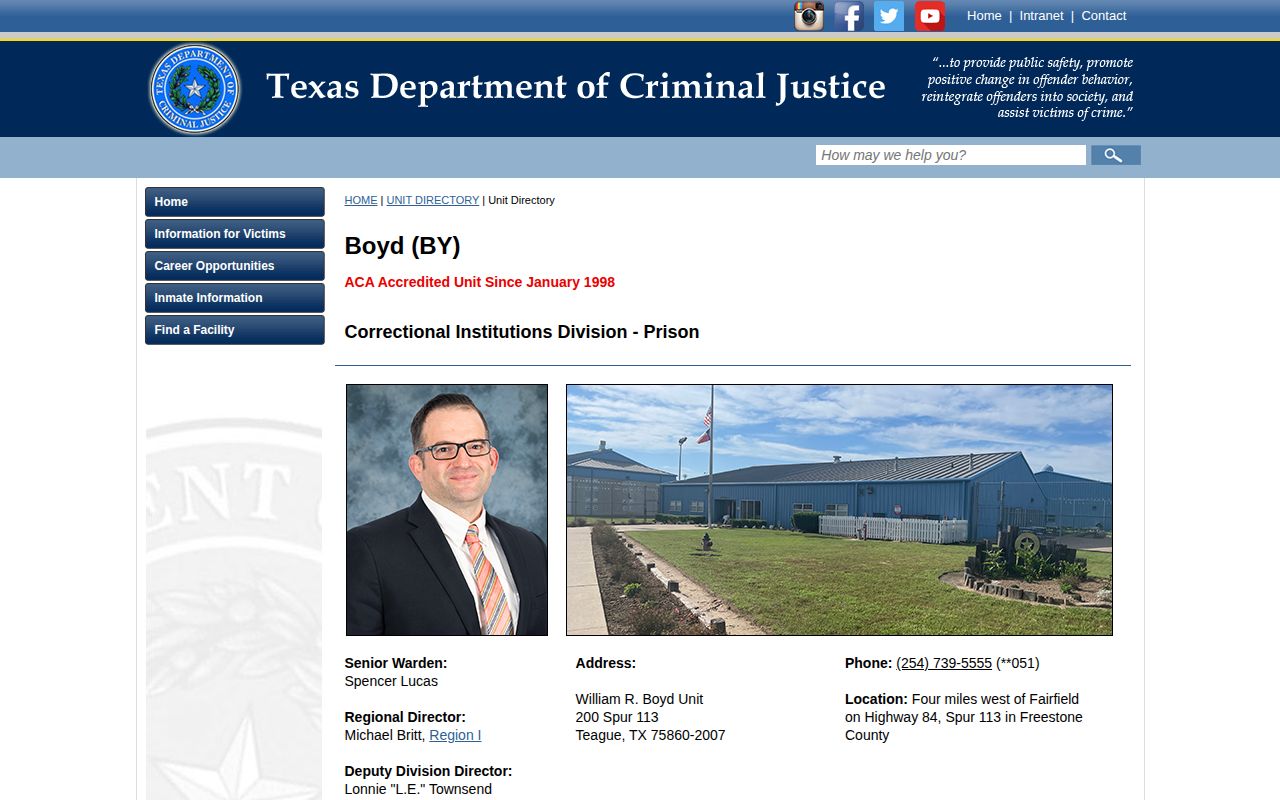
The directory establishes Boyd’s role, but it does not prove a named person left custody. TDCJ may transfer someone to another unit or a regional release site before parole, mandatory supervision, or discharge.
| System | Who it covers | Release proof |
|---|---|---|
| Freestone County Jail | Local Sheriff bookings | Sheriff release record and court file |
| William R. Boyd Unit | TDCJ prisoners | TDCJ status, IVSS, and actual release date |
| Municipal holding | Brief police processing where applicable | Arresting agency and FCSO transfer record |
| Federal custody | Federal prisoners and pretrial detainees | BOP locator, docket, or USMS record |
| Immigration custody | ICE detainees and transfers | ICE ODLS or DRIL confirmation |
The complete facility set is Freestone County Jail, William R. Boyd Unit, Freestone County Municipal Holding, Federal Custody Serving Freestone County, and Immigration Custody Serving Freestone County. The sidebar and footer route to each facility page.
Freestone Custody Search Comparison
Choose the record by custody type and by the question being asked. Current-custody tools answer where a person is now. Release records explain how one custody episode ended. Court records explain the legal action. No single database covers all three.
| Situation | Use first | Do not assume |
|---|---|---|
| Recently left county jail | Sheriff release record | Roster absence equals community release |
| Sent to or released from TDCJ | TDCJ offender search and IVSS | Leaving Boyd equals discharge |
| Bond or court order | County or District Clerk | A booking page shows final disposition |
| Federal custody | BOP plus docket or USMS records | “Not in BOP Custody” means no other hold |
| Immigration transfer | ICE ODLS or DRIL | Leaving the county jail means release |
For an ICE search, ODLS uses an A-number and country of birth or exact biographical details. It may retain some released records for a limited period, but a missing result still needs agency confirmation. People under 18 do not appear. The ICE Detention Reporting and Information Line is another official route when the online result is unclear.
For a federal pretrial case, the public BOP locator may not describe the USMS custody trail. Follow the federal docket and request the correct USMS record. A BOP result marked “Released” or “Not in BOP Custody” establishes only that BOP no longer holds the person. Another authority may still have custody.
The Texas DPS Public Sex Offender Registry is relevant only when a person has a Chapter 62 registration duty. It can show a photo, offense, address, and supervision or discharge indicator, but it is not a general release database. Its absence says nothing about a person who has no registration duty.